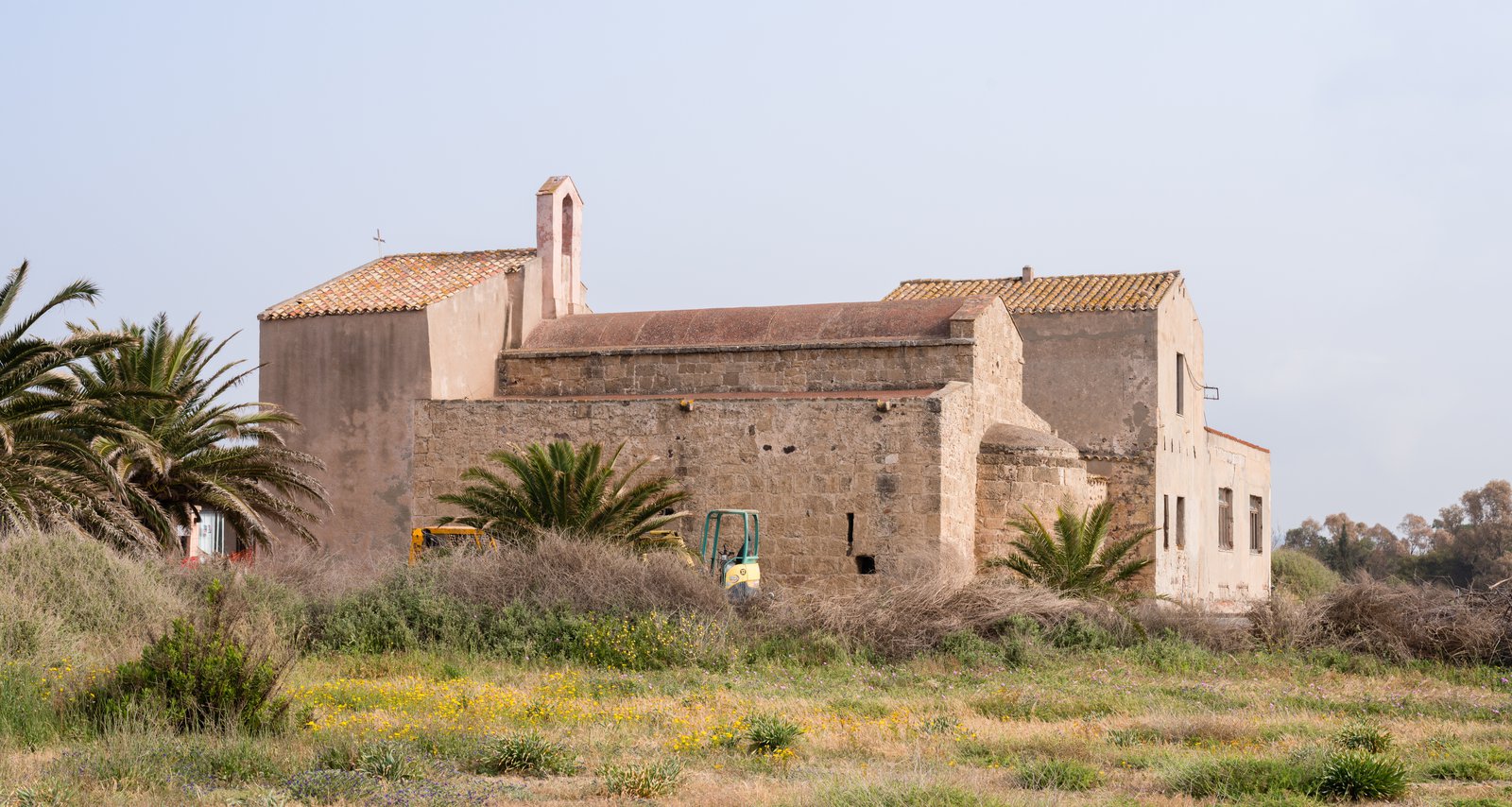
1. Chiesetta di Sant'Efisio di Nora: Romanesque Martyrdom on the Beach
Standing only thirty paces from the gentle surf of Spiaggia di Nora, the Chiesa di Sant'Efisio is one of the most spiritually poignant shrines in the Mediterranean. Consecrated in 1089 by Victorine monks from Marseille upon land granted by the Judike of Cagliari, the three-nave Romanesque basilica was erected directly over an early Christian subterranean crypt (ipogeo).
According to hagiographical tradition, Efisio—a Christian convert and Roman military commander originating from Antioch—was martyred here on January 15, 303 AD, during the Diocletianic Persecution after refusing to renounce his faith. The builders of the medieval church recycled massive dressed blocks of red trachyte, sandstone, and porous limestone directly from the adjacent ruined Roman forum of Nora.
It was in the perimeter drystone wall surrounding this very churchyard that the celebrated Nora Stone (Stele di Nora) was discovered in 1773, bearing the Phoenician name ŠRDN (Sardinia). Every year on May 2nd, the historic effigy of the saint is carried here from Cagliari in a majestic 65-kilometre religious procession that has taken place without interruption since 1657.
2. Torre del Coltellazzo: The Spanish Aragon Sentinel
Dominating the highest rocky prominence of the eastern promontory, the Torre del Coltellazzo (also recorded in civic archives as Torre di Sant'Efisio) was constructed around 1595–1600 by the Spanish Crown under King Philip II. Positioned forty-five meters above sea level, the tower served as an armed maritime radar station within the defensive network engineered by the Royal Administration of the Towers (Reale Amministrazione delle Torri) to defend southern Sardinian shores against Barbary pirate incursions.
Constructed from local granite blocks and volcanic quarry stones mined directly from Nora's Roman breakwaters, the tower features a truncated cone profile with an external diameter of roughly twelve meters. A vaulted gunroom housed two light bronze cannons (cannoniere) capable of sweeping both the Golfo degli Angeli and the eastern lagoon channel. Today, visitors can ascend the rocky foothill trail wrapping around the excavation park fence to enjoy a panoramic view spanning Capo Spartivento to the west and the devil's saddle of Cagliari (Sella del Diavolo) to the east.
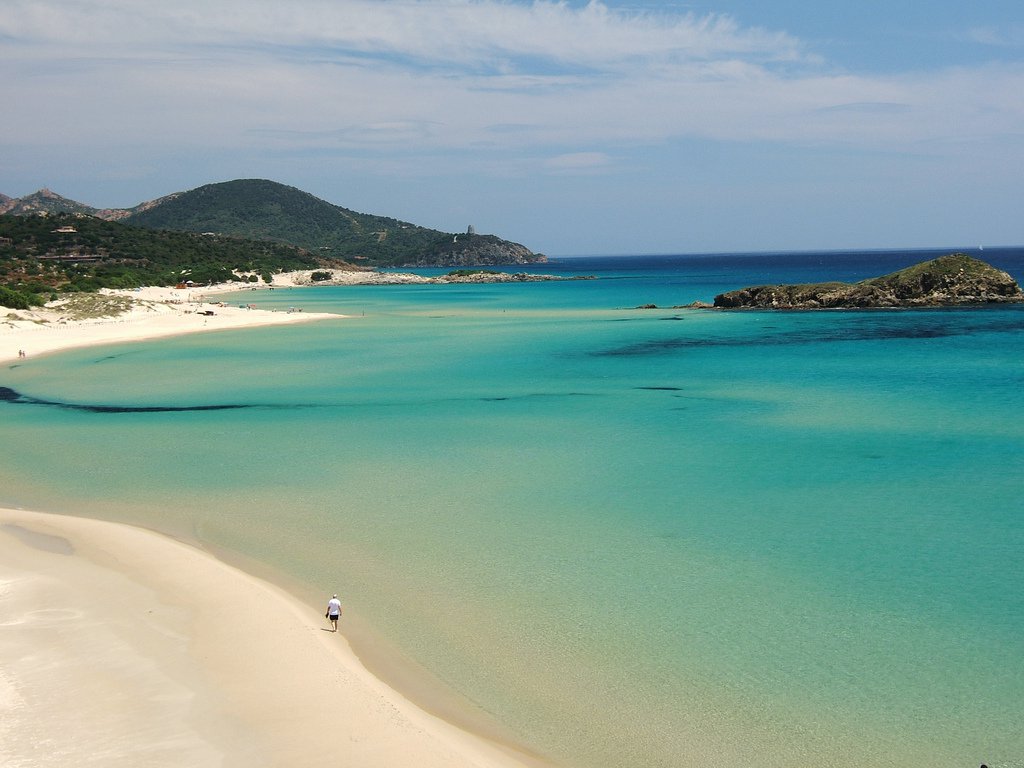
3. CEAS Laguna di Nora: Marine Biology & Sea Turtle Rescue
Immediately north of the archaeological boundary gate lies the Stagno di Nora, a brackish lagoon basin covering roughly thirty hectares sheltered behind coastal sandstone barriers. The lagoon is managed by the Centro di Educazione Ambientale e Sostenibilità (CEAS Laguna di Nora), an active scientific station dedicated to coastal biodiversity preservation and marine fauna rehabilitation.
The center operates the Clinica delle Tartarughe Marine (Sea Turtle Rescue Hospital), where injured specimens of Loggerhead sea turtles (Caretta caretta) recovered along southern Sardinian fishing waters undergo veterinary surgery and rehabilitation before maritime release. Visitors can tour the rehabilitation pools, visit the Mediterranean aquarium exhibiting local fish species, and rent sea kayaks for eco-tours weaving through the ancient sunken Roman quays lining the lagoon perimeter.
4. The Southwestern Coastal Arc: Chia, Tuerredda & Capo Spartivento
No archaeological field inspection of Nora is complete without exploring the pristine coastal arc stretching fifteen to twenty-five kilometres southwest along the panoramic SS195 highway:
- Spiaggia di Su Giudeu (Chia): Renowned for thirty-meter-high golden sand dunes sculpted by the Mistral wind and ancient Phoenician juniper groves. The shallow sandy seabed extends over fifty meters into calm, emerald-tinted water.
- Cala Cipolla: A sheltered granite cove framed by pink porphyry headlands, offering total protection from northwesterly winds and exceptional snorkeling conditions around underwater granite reefs.
- Capo Spartivento: The southwesternmost headland of Sardinia, crowned by a still-active 19th-century naval lighthouse. The surrounding coastal trails follow ancient Spanish patrol paths overlooking uninhabited granite islands.
- Spiaggia di Tuerredda: A world-famous Caribbean-like bay situated between Capo Malfatano and Capo Spartivento, sheltered by an offshore islet reachable by a brief swim.